
On this page
- Understanding Marble: A Calcium Carbonate Surface
- The Difference Between Dirt and Damage On Marble
- Why Cleaning Can’t Fix Etching
- General Marble Cleaning That’s Actually Effective
- What NOT to Use on Marble (Clear Red Flags)
- Sealing Marble: What It Does and Doesn’t Do
- The Truth About Stains on Marble
- Prevention: The Only Reliable Strategy
- Normal Wear vs Tenant Damage
- End of Lease Reality: What Cleaners Can and Can’t Do
- When to Stop and Call a Professional
- Marble Polishing By a Specialist
- When to call a professional
- Frequently Asked Questions
- If your benchtop is quartz rather than marble
- Reseal every six to twelve months, or when water soaks in
- Sealing slows staining but does not prevent etching
- Bond cleaners can't reverse etching or repair chemical damage
Marble finishes are a beautiful addition to any home, but they are also an expensive one that requires special attention to maintain its beauty over time. Cleaning marble properly isn’t about using stronger products or more effort; it’s about understanding what the material is, how it reacts to certain products, and when cleaning becomes ineffective.
Unlike surfaces with less porosity like quartz, marble cannot be cleaned by just any household cleaner. This guide will cover everything that you need to know about cleaning and maintaining your marble tiles or slabs, including which products you can and can’t use, and when it might be time for some touch-up work.
Understanding Marble: A Calcium Carbonate Surface
Marble is a natural stone made primarily of calcium carbonate. While it appears solid and durable, it is actually porous and reactive to certain chemicals and acids.
Its composition is what makes marble both attractive and vulnerable. Unlike engineered stone, marble is sensitive to even mild acidic agents. When that reaction occurs, it doesn’t just mark or stain the surface, it eats away at the material itself. Common household substances like citrus juice, vinegar, and even some “natural” cleaners can etch the finish almost instantly.
For this reason, it’s important to keep in mind that a natural material like marble doesn’t just get dirty, it can be chemically altered if you’re not careful.
The Difference Between Dirt and Damage On Marble
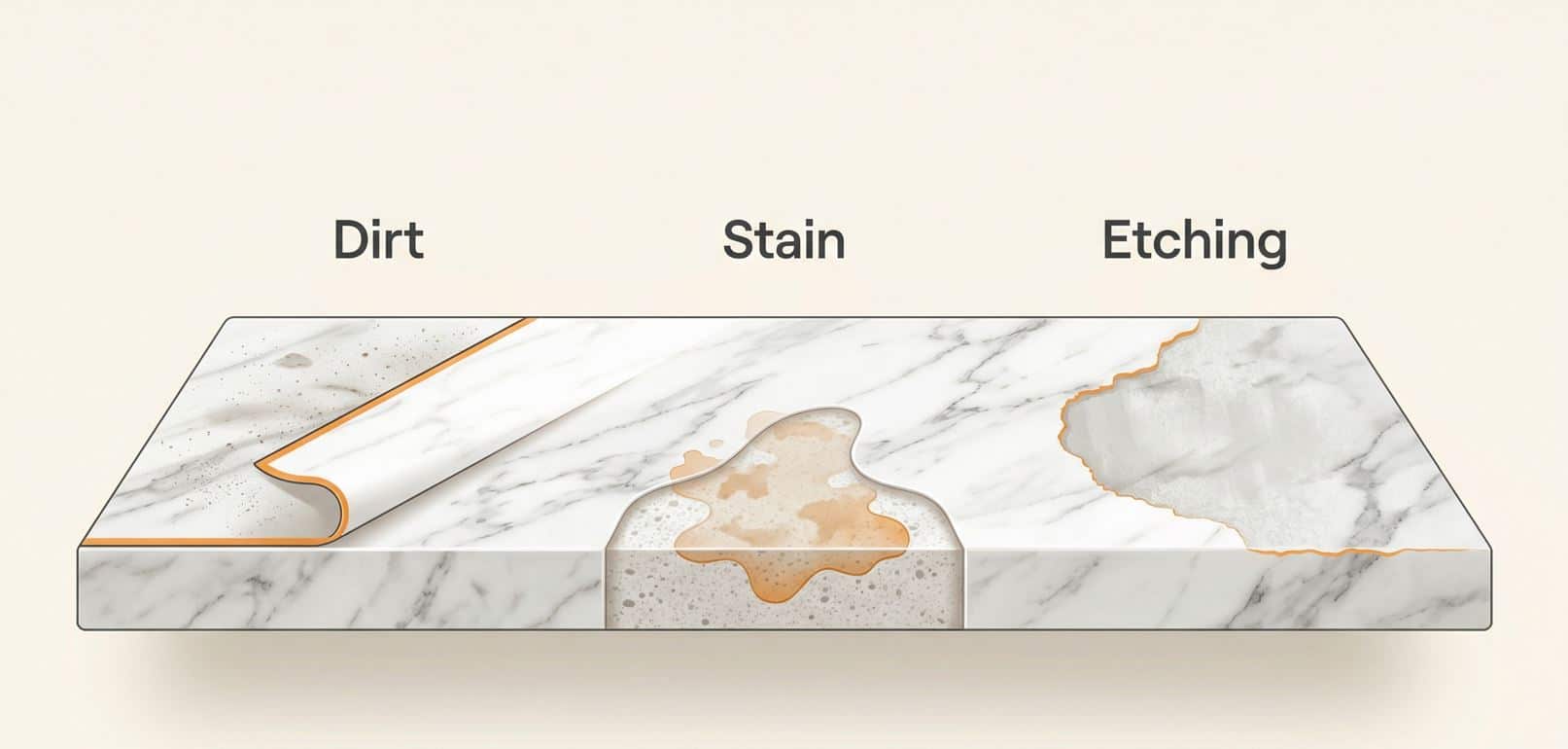
A common misconception is that any mark on marble can be cleaned off with the right product or enough effort. However, in reality, marble surfaces are affected in two very different ways: staining and etching.
Stains occur when liquids are absorbed into the stone’s porous material, causing discolouration. Etching, on the other hand, is damage caused by acids reacting with the calcium carbonate in the stone. This dulls the surface and also changes its texture.
Bear in mind:
- Stains sit within the stone and can sometimes be removed with the proper cleaning method.
- Etching is surface damage and cannot be cleaned away, but instead requires grinding or polishing to remove.
Understanding these differences is critical, especially in end of lease situations where etching is expected to be removed by bond cleaners but ends up flagged in the inspection report because it is outside their scope of work.
Why Cleaning Can’t Fix Etching
Etching occurs when the top layer of the marble stone gets dissolved. It may not be visible to the naked eye at first, but over time, the marks become evident. What you’re left with is a dull or cloudy patch that can feel slightly rough to the touch.
At this point, cleaning is no longer the solution. Scrubbing harder or trying different cleaning products and methods won’t restore the finish; in fact, it can often make the contrast more noticeable. The only way to correct it is through mechanical processes such as honing or polishing.
This is where many DIY attempts go wrong because cleaning attempts only worsen what is meant to be a restoration project.
General Marble Cleaning That’s Actually Effective
For everyday cleaning, marble is fairly simple to maintain when you stick to a safe and consistent method. A pH-neutral cleaner should be your product of choice, as it is safe for natural stone. Alternatively, a very mild soap solution paired with a soft cloth is suitable for general cleaning.
Gentle wiping, followed by drying the surface, helps maintain the finish without causing unnecessary wear. This also reduces the risk of streaks or water spots forming, particularly on polished marble where marks can be more noticeable under light. Daily maintenance is important as it prevents surface build-up that would then require more intensive cleaning.
Over time, consistent care not only preserves the appearance of the marble but also helps extend the life of its finish.
| What you notice | What to do |
|---|---|
| Everyday dirt and residue | pH-neutral cleaner or mild soap, soft cloth, then dry |
| Fresh spill | Wipe it up straight away to prevent a stain |
| Old or stubborn stain | Seek professional advice rather than stronger DIY solutions |
| Dull, cloudy or rough patch | Likely etching; needs honing or polishing by a specialist |
| Water soaks in instead of beading | Sealer is worn; reseal, usually every six to twelve months |
What NOT to Use on Marble (Clear Red Flags)
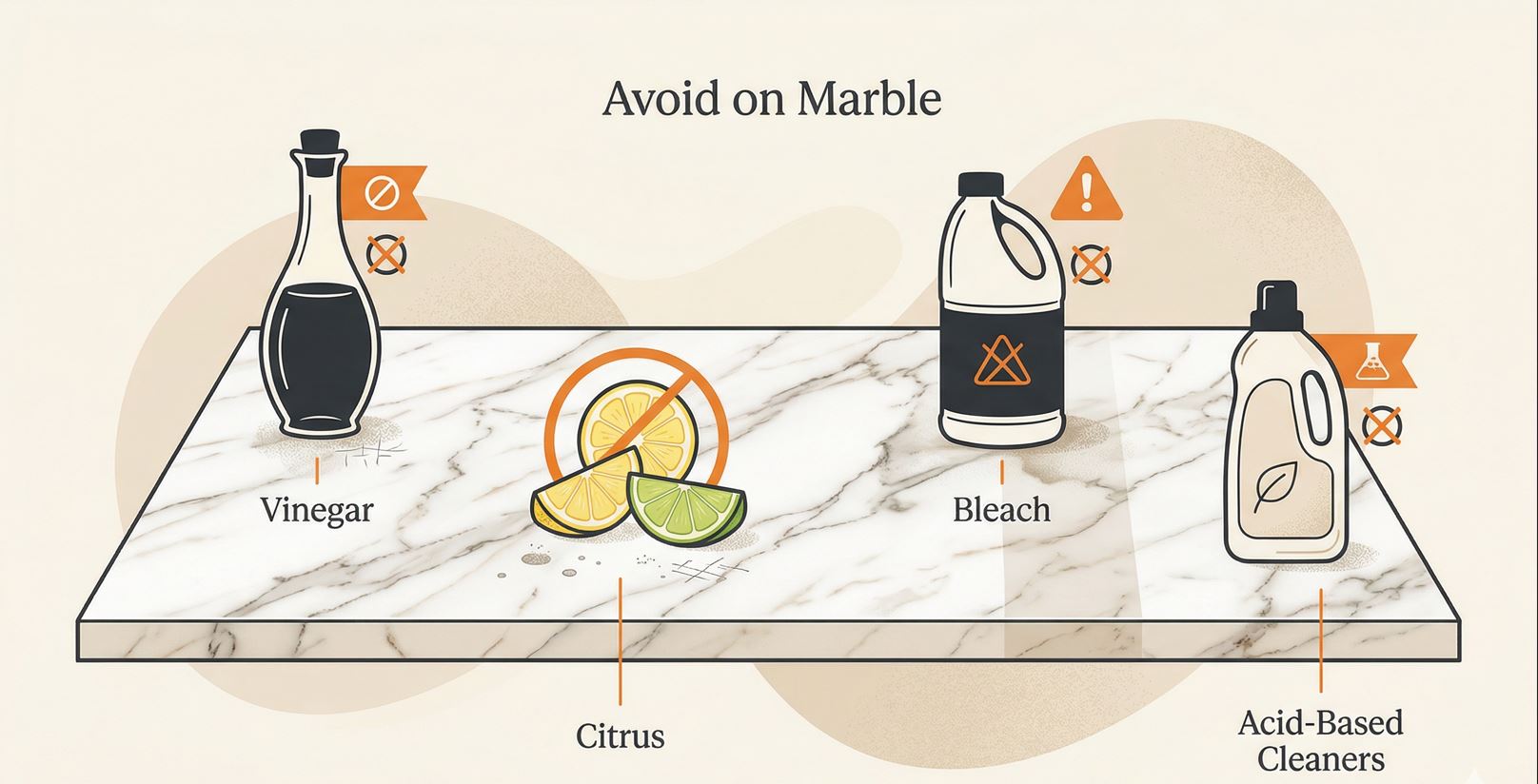
Most marble damage doesn’t come from neglect, but instead from improper cleaning solutions. Using the wrong product, even in small amounts, can permanently alter the surface.
Here are some common household products used in cleaning which are NOT suitable for marble:
Vinegar
Vinegar is highly acidic, and because marble is made of calcium carbonate, it reacts immediately upon contact. This reaction causes etching, which not only dulls the surface but causes permanent marks that cannot be ‘cleaned off’.
Citrus
Citrus fruits like lemon and lime contain natural acids that have the same effect as vinegar. Even a few drops can etch the surface, especially if left sitting for too long. Citrus is therefore one of the most common causes of dull spots on marble.
Bleach
Bleach is not acidic, but it is still definitely too harsh for marble. It can discolour the stone and gradually break down any protective sealer, leaving the surface more vulnerable to stains, buildup, and further damage.
“Natural” Acids
Many “natural” cleaning products are often assumed to be safe for cleaning marble. However, these products can contain ingredients like citric acid, which will react with marble in the same way as their raw form does, causing etching and surface damage despite their eco-friendly label.
Sealing Marble: What It Does and Doesn’t Do
One of the best things you can do for your marble is to seal it. That said, many homeowners misunderstand what a sealer can and can’t do for the stone. While it helps slow down how quickly liquids are absorbed, giving you more time to clean up spills before they turn into stains, it does not prevent etching.
It’s also worth noting that sealed marble isn’t protected from acidic agents. Similarly, sealers don’t make the stone completely stain-proof. Lastly, sealers get worn over time and need to be reapplied every six to twelve months depending on use. A simple way to test if your marble needs to be resealed is to check whether water beads on the surface or soaks in; the latter is a clear sign of a worn sealer.
The Truth About Stains on Marble
When marble gets stained, many homeowners panic and resort to using stronger cleaning solutions in the hope of removing it. This is where bigger problems tend to occur.
Aggressive DIY solutions can actually cause stains to set deeper into the stone or damage the surrounding finish, leaving the surface looking uneven. For fresh spills, immediate clean-ups are generally enough to prevent permanent stains. On the other hand, if a stain has been sitting for a while or was caused by something that’s harder to remove, it’s best to seek professional advice.
Prevention: The Only Reliable Strategy
When it comes to marble surfaces, prevention is what you really ought to focus on. Once the surface has been etched or damaged, restoring it requires specialised work, and that can be costly depending on the extent of the damage.
These simple habits can help prevent serious problems with your marble:
- Wipe spills as soon as they happen
- Keep harsh or acidic products off or away from the surface
- Use rubber mats or trays when placing potentially reactive items on benchtops
- Avoid contact with residue from strong cleaning agents, such as placing cleaning tools with residue directly on the surface.
These small steps help preserve the finish and reduce the likelihood of permanent damage.
Normal Wear vs Tenant Damage
For renters in Sydney, marble care is an important part of property maintenance. Even with proper use and care, the stone surface gradually changes over a period of time.
Light etching, minor dulling, and subtle variations in the finish are inevitable and considered normal wear and tear. Damage, however, is more significant and usually the result of improper care. Deep chips, cracks, heavy etching from harsh cleaning products, or burns caused by chemical exposure are rightfully classified as tenant damage.
Unfortunately, bond disputes often arise due to misclassification. Property managers and agents don’t always do the best job at distinguishing between normal wear and actual damage, leading to unrealistic expectations during inspections. When etching from regular use and age is treated as a cleaning issue or assumed to be caused by improper use, tenants get blamed for it.
End of Lease Reality: What Cleaners Can and Can’t Do
Professional bond cleaners are responsible for completing tasks on their end of lease cleaning checklist, which does not include repairs of any kind. Therefore, property managers and tenants alike need to understand what is and isn’t within their scope of work.
Here’s what to expect from cleaners when it comes to marble care:
- Removal of dirt, grease, and surface residue
- Improvements to the overall appearance of marble surfaces
What they can’t do is reverse etching or repair chemical damage. Similarly, bond cleaners are not responsible for restoring worn or damaged finishes. This requires specialised equipment and technical expertise, which lies outside a cleaner’s scope of work.
Attempting to polish or restore it yourself without prior experience or knowledge of the correct process can leave the surface uneven or further damaged.
When to Stop and Call a Professional
When an exit inspection is looming, it’s natural to want every marble surface looking its best. Unfortunately, cleaning in haste is when the most visible mistakes happen. Using strong products or unverified home remedies without a second thought can create larger dull patches or inconsistencies in the finish.
With that said, there are clear signs that point to the need for professional assistance:
- The surface begins absorbing liquids quickly, indicating sealer failure
- Large areas appear dull or cloudy, suggesting widespread etching
- The finish feels rough or uneven, meaning honing is required
Addressing these issues early helps prevent further damage, and calling in a professional is your best option for restoring the marble’s perfect finish.
Marble Polishing By a Specialist
If a marble surface appears dull, patchy, or uneven after regularly maintaining it, the issue is not cleaning-related. At this stage, it needs to be inspected and restored by a professional.
This process may involve honing to remove a thin layer of the surface to make it even and reveal a fresh layer of the stone, followed by polishing to restore the finish. It requires specialised tools like polishing pads and appropriate diamond grits to achieve the desired finish. It must be noted that this process cannot be replicated with household tools or general cleaning services.
Marble is a beautiful, natural stone, but it does come with limitations. Maintaining it is never about aggressive cleaning, but rather understanding how it reacts to certain cleaning agents and household products.
Because marble is made of calcium carbonate, chemical reactions from acidic substances are the biggest concern. It causes etching which can’t be cleaned away, nor can it be reversed. While sealing helps to prevent immediate stains, it does not protect the stone surface from damage.
Daily cleaning in the form of gentle wipe downs using a soft cloth and pH-neutral cleaning solutions is highly recommended for long-term maintenance. Beyond that, knowing when to call in a specialist can make a significant difference, especially for an end of lease inspection where marble surfaces are closely looked at.
When to call a professional
Dull or cloudy patches, a rough feel and liquids soaking straight in are signs of etching or a failed sealer, which no clean can fix. A stone restoration specialist can hone, polish and reseal the surface. Bond cleaners can remove dirt and residue before an inspection, but restoring the finish is outside their scope.
Frequently Asked Questions
What Can I Use to Get Stains Out of Marble?
A number of products can be used to safely remove stains from marble including hydrogen peroxide, dishwashing liquid, rubbing alcohol, acetone, and cornstarch.
Is Baking Soda Safe for Marble?
Due to its mild abrasion and alkaline content, baking soda is typically not recommended for marble surfaces. It can, however, be used occasionally by mixing with water, and applying a very gentle pressure to remove stains on marble. Overusing the ingredient will dull the material overtime.
Can I Use a Magic Eraser on Marble Surfaces?
It is best to steer clear of Magic Erasers when cleaning marble surfaces because they are abrasive. Along with scratching the surface, Magic Erasers can dull marble and damage any existing sealant.
Does Water Stain Marble?
Hard water will stain marble because it contains mineral deposits. Due to its porous material, marble is easily stained by minerals and therefore, pure water must be used when cleaning marble surfaces.
How Do You Fix a Water Stain on Marble Surfaces?
A commercial marble cleaner will get rid of water stains on marble surfaces. Simply apply the product to the affected area, and then rub the stain gently with a soft towel.
How Can I Make My Marble White Again?
A non-abrasive alkaline marble cleaner will get rid of discolouration, and make the marble appear white again. Follow the instructions on the label, and be sure to double check that the cleaning product does not contain acid as this will dull the marble’s polished finish.
Can I Use A Specialist Tile Machine To Clean Marble?
Yes, absolutely, you just need to follow the manufacturer’s guidelines and make sure the machine is suitable for cleaning natural stone tile surfaces. Check out our tile machine buyer’s guide for more information.
If your benchtop is quartz rather than marble
Engineered quartz and marble need different care. For quartz, begin with a soft cloth, warm water and mild detergent, then rinse and dry. Treat stubborn marks only with a cleaner approved for the surface and finish. Do not transfer marble sealing or polishing advice to quartz. Caesarstone provides quartz care instructions, including testing cleaners on an inconspicuous area. Cracks, chips and altered finishes need repair advice rather than stronger cleaning.