
Cleaning Tips, Guides & Resources
How to Become an NDIS Cleaner in Australia: Requirements, Pay and NSW Guidelines
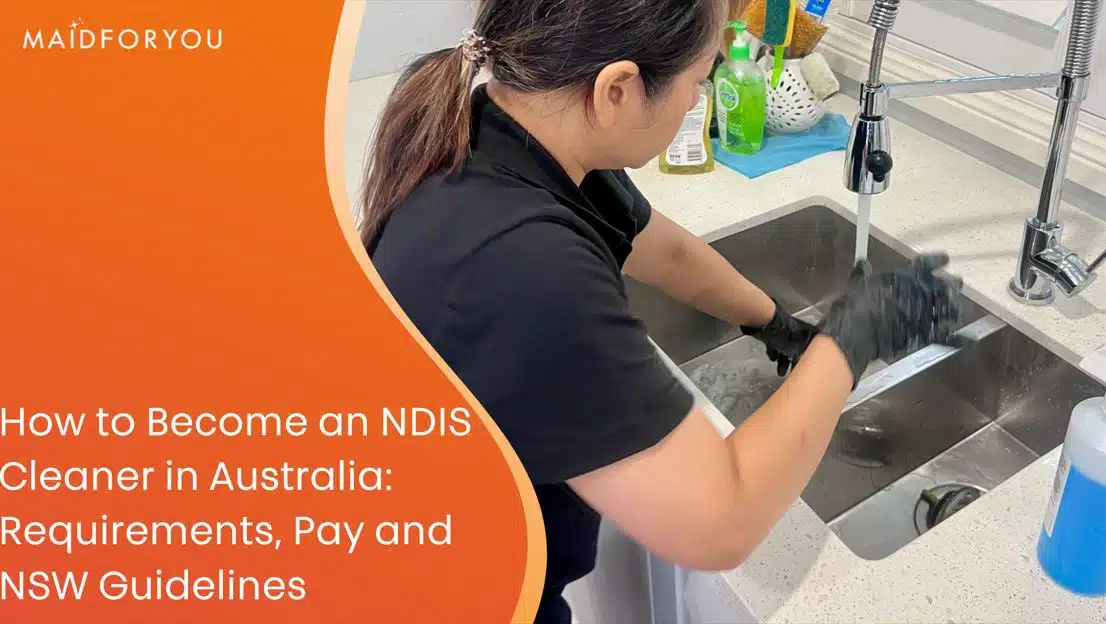
If you’re considering a career in cleaning and want work that is both flexible and fulfilling, becoming an NDIS cleaner is a great option. It means working under the guidelines set by the National Disability Insurance Scheme (NDIS), which supports people living with disabilities by funding essential services such as household cleaning.
The demand for these services is steadily growing across Australia, encouraging more cleaners to join the NDIS sector and pursue a rewarding career. Getting started, however, involves more than just cleaning experience; there are specific requirements and expectations that one must understand before applying to become an NDIS cleaner.
In this guide, we’ll walk you through what an NDIS cleaner does, what it takes to become one, and the steps to get started.
What is NDIS Cleaning?
The National Disability Insurance Scheme (NDIS) is funded and managed by the National Disability Insurance Agency (NDIA). Under this scheme, Australians living with disabilities can access different types of support to improve their overall quality of life. This includes funding for healthcare and, of course, NDIS cleaning.
Unlike end of lease or regular cleaning services, NDIS cleaning is typically customised and provided for participants whose NDIS plans include support for maintaining their household. These services are offered only if the NDIA considers them to be “reasonable and necessary,” with the primary goal of keeping living spaces clean, safe, and comfortable for individuals who find it challenging to complete household chores due to their disability.
What Do NDIS Cleaners Do?
NDIS cleaning goes beyond standard residential cleaning because services must be tailored to suit the unique needs of each participant. Cleaners are trained to work under strict guidelines, as mentioned in the written agreement, between the provider (cleaning company) and the participant. It is important that cleaners consider the individual’s mobility limitations, health requirements, personal preferences, and the level of support outlined in their NDIS plan.
The type of cleaning work can vary depending on the provider and the participant’s support requirements. NDIS cleaners typically help with a range of everyday household chores and some detailed cleaning tasks to ensure a safe and hygienic home environment. Common responsibilities may include washing dishes, dusting surfaces, vacuuming and mopping floors, cleaning bathrooms, changing bed linen, and sanitising kitchen areas and appliances.
In many cases, cleaners also go the extra mile and take care of miscellaneous tasks like wiping down and sanitising a participant’s mobility or rehabilitation equipment, organising spaces, or checking for expired food items and removing them while cleaning the fridge.
To ensure reliable, high-quality NDIS cleaning services, good communication between the cleaner, the participant, their family or carers, and Support Coordinators or Plan Managers is key.
Can Anyone Become an NDIS Cleaner in Australia?
The opportunity to become an NDIS cleaner is open to people from a wide range of backgrounds, irrespective of whether you have prior cleaning experience. For both new and experienced cleaners, many companies provide training to equip them with the skills and knowledge needed to work confidently with NDIS participants.
Employers often look for reliability, attention to detail, consistency, and a respectful attitude, as these qualities are essential when working in participants’ homes and supporting them.
Requirements for Working as an NDIS Cleaner
While experience, or lack thereof, isn’t a problem, there are some important requirements that must be met to become an NDIS cleaner. This can vary between independent cleaners and those working with an NDIS-registered cleaning business. To legally work as an independent worker, you will need to purchase public liability insurance, register your business name with the Australian Securities and Investments Commission (ASIC), and obtain an Australian Business Number (ABN). Once you have the above in place, you can legally work as an NDIS cleaner, manage your taxes, and send invoices for your services.
They must also complete the NDIS Worker Orientation Module, follow the NDIS Code of Conduct, and pass required background checks, including a National Police Check and an NDIS Worker Screening Check. These checks are typically mandatory if you decide to work with a registered provider, and if applicable, you will also need to clear a Working With Children check.
Steps to Become an NDIS Cleaner
When compared to regular cleaning roles, becoming an NDIS cleaner involves a few extra steps, as the role involves supporting people living with disability in a safe and respectful environment.
Along with standard job requirements such as a good resume and a driver’s license, cleaners must complete mandatory screening checks (as mentioned earlier) before working with participants. Many cleaning companies help applicants navigate the process, and some even cover the costs involved.
Here’s what you’ll need to do to start your career in NDIS cleaning.
1. Applying to Become an NDIS Cleaner
The first step is to apply to a cleaning company by sending your resume and a short cover letter. Your resume should list your previous jobs, skills, qualifications and/or any training you have completed. In the cover letter, you can explain why you’re interested in the role and what makes you a good candidate. Make sure to include important details such as your full name, contact information, and location.
For selected candidates, the company will set up an interview to further discuss their experience, availability, and suitability for working as an NDIS cleaner. Depending on the provider, there may be a second interview before hiring the individual and completing the required background checks.
2. NDIS Worker Screening Check
In order to confirm if an individual is suitable to work with NDIS participants, they must complete an NDIS Worker Screening Check. This is done through the NDIS Worker Screening Unit in the relevant state or territory and is compulsory for anyone employed by a registered NDIS provider. They also handle the National Police Check and Risk Assessment.
Since the check is recognised across Australia, individuals only need to apply once. If approved, it can be used anywhere in the country should they move to another state or territory. The check is valid for five years unless it is cancelled or expires earlier.
3. Understanding the NDIS Code of Conduct
The NDIS Quality and Safeguards Commission developed the NDIS Code of Conduct to set the standards for behaviour expected from providers and workers delivering cleaning services to NDIS participants. It is intended to ensure safe, respectful, and ethical services are provided at all times.
Abiding by the Code means working honestly and transparently; providing services safely and with care; and charging fair and reasonable prices. These guidelines apply to all registered and unregistered providers, as well as their staff and contractors. The NDIS Worker Orientation Module serves as a guide to help individuals learn how to work in accordance with the Code.
How Much Can You Earn as an NDIS Cleaner?
The NDIA controls how much a registered provider can charge for services through the NDIS Pricing Arrangements and Price Limits. From July 2025 to June 2026, household supports and cleaning is capped at $58.03 per hour nationally; however, remote areas have a higher limit. In some cases, travel costs may also be claimable.
That said, a cleaner’s actual pay depends on how they work. Independent contractors can charge any amount within the NDIS limit but cover their own expenses and admin. Cleaners employed by companies are paid under the Fair Work Award and receive fixed income, regular work hours, and paid leave, while their employer manages scheduling, invoices, and paperwork.
What Most New NDIS Cleaners Get Wrong
We’ve found NDIS cleaning to be both equally rewarding and challenging. There are some avoidable mistakes that new NDIS cleaners often make. Avoiding them will likely save newcomers a lot of headache and heartache and enable a rewarding professional career whilst encouraging and providing a safe and reliable cleaning service to NDIS participants.
Scope Limits in NDIS Plans
Not understanding scope limits in NDIS plans is one of the most common mistakes new cleaners make. Cleaning services fall under ‘Assistance with Daily Life’ or ‘Household Tasks’ within Core Supports.
New cleaners may be pressured or agree to do additional tasks without these tasks being explicitly funded, often leading to invoice disputes, unpaid work, or confusion between NDIS stakeholders.
We learnt early on the need to avoid misunderstandings like these, and we take steps to make sure there’s no confusion in our service provision for our NDIS clients.
As a standard, we always confirm the support item being claimed with the participant or with the Plan Manager. Our teams are all aware of what’s included in a client’s service agreement, and we make sure to advise both clients and Plan Managers if specific tasks may fall outside an approved cleaning scope.
Confusing Cleaning with High-Care Support
NDIS cleaning and disability support work are completely different roles, and mixing the two can often lead to complications in service provision. At an extreme, it can lead to dangerous situations for both NDIS participants and their cleaners.
High-care support requires stringent training in personal care tasks and mobility assistance best practice.
We’ve noticed that many new cleaners often feel pressured to assist our clients with personal care when this is well outside our scope.
New NDIS cleaners should always be sure to focus strictly on the funded house cleaning tasks, avoid personal care or mobility assistance even when properly trained, and always escalate any concerns to the client’s NDIS Support Coordinator if additional high-care support is requested by the NDIS participant.
Not Maintaining Professional Relationships with Support Coordinators and Plan Managers
We’ve found this to be the biggest hack to provide good service provision to NDIS participants without confusion. Making sure to be in constant contact with the staff who assist our NDIS clients really helps to streamline our service and avoid disputes.
We’ve found new NDIS cleaners overlook the importance of maintaining professional relationships and clear lines of communication with these stakeholders.
As a business, we have KPIs (key performance indicators) on how quickly we respond to emails, how promptly we send invoices, and how we address complaints and concerns. This enables us to build trust with Support Coordinators and Plan Managers, which leads to long-term referrals, stable work, and most importantly, happy NDIS participants.
Not Ensuring Clear Boundaries Are Set
The vast majority of the cleaning we do for our NDIS clients is recurring in nature. That means we clean for them fortnightly, weekly, or monthly, with weekly cleans being the most popular. Over time, cleaners and NDIS participants can develop personal relationships, which can blur the boundaries between client and cleaner.
That’s why it’s essential for newcomers to always set clear boundaries. Have clear service agreements, respectful communication, and a defined cleaning checklist and schedule to ensure a professional working relationship.
NDIS Cleaners in Sydney: What You Need to Know
While the NDIS operates nationally, working as an NDIS cleaner presents unique considerations and challenges for new cleaners.
Areas of Demand
We’ve found that there is a strong demand for disability support services and subsequent cleaners in suburbs throughout Western, South West, and North West Sydney.
For cleaners who are new to the NDIS and are seeking to onboard clients, suburbs like Blacktown, Parramatta, Liverpool, Hornsby, Bankstown, Riverwood, and Casula from our list of customers have growing NDIS participant populations.
Many participants in these suburbs require ongoing cleaning support on a fortnightly or weekly basis, particularly those living independently or in subsidised housing arrangements.
Managing Travel Time
Sydney is a city of urban sprawl. Its size and traffic conditions can often impact scheduling and travel time between clients. Servicing clients in Sydney’s inner city can also prove challenging, as parking availability can be limited.
We recommend that new NDIS cleaners schedule jobs within a particular area on a particular day. That way, you can avoid traffic congestion, reduce travel time between jobs, improve the profitability of your service provision, and reduce fatigue.
Scheduling participants in the same area on specific days of the week also leads to less lateness, fewer cancellations at the door, and happier NDIS clients.
How NSW Differs from Other States
NSW has a large concentration of registered NDIS providers. As a result, the Sydney market is competitive, and we’ve found over the years that it has become increasingly saturated, especially with companies providing NDIS cleaning services.
Companies in Sydney can set themselves apart from the competition by providing a uniform service across participants, ensuring fast and prompt communication, and being punctual to cleaning appointments.
What to Expect Working as an NDIS Cleaner
Understanding the day-to-day realities of NDIS cleaning helps with managing and setting accurate expectations for new NDIS cleaners and participants. We’ve found that the average job length for cleaning visits typically ranges from 3 to 4 labour hours, with deep initial cleans often taking double or triple that amount of time depending on the condition of the home.
The most typical cleaning tasks that our cleaners engage in when cleaning for NDIS participants are vacuuming, mopping, cleaning surfaces throughout the common areas of a home, and changing bedsheets. We’ve found the great thing about NDIS cleaning is that it enables more flexible working arrangements than regular cleaning or end-of-lease cleaning services.
Some of our top-rated cleaners can spend upwards of 30 hours a week in the homes of NDIS participants, while other cleaners are able to commit to a part-time schedule of 20 hours per week. So there’s something for everyone.
Becoming an NDIS cleaner offers flexible, meaningful work supporting people with disabilities through funded household cleaning services.
Demand for these roles is growing across Australia, but getting started involves meeting specific requirements, including screening checks, training, and following the NDIS Code of Conduct. Duties go beyond standard cleaning, focusing on safe, personalised support tailored to each participant’s needs.
Cleaners can work independently or with a registered provider, with earnings guided by NDIS pricing limits. With the right preparation, NDIS cleaning can be a stable and rewarding career path.

Adriana Aziz is the operations manager at MaidForYou. With over 6 years of experience managing cleaning operations, she knows all the best hacks when it comes to cleaning residential and commercial buildings. With expert experience in managing house cleaning operations, interior design and logistics. She spends her free time with her family and as a freelance food critic.
As seen on...


We’re Committed To 200% Customer Satisfaction Each And Every Time
If you’re not happy with our work, we make it right!


Be the first to comment.