
On this page
Data note: MaidForYou figures in this article come from our own booking and payout records in Launch27, 2014 to August 2026, cancellations excluded, compiled by Delah Gomasi. Industry figures are from the public sources cited in the text.
- Casual cleaners get a 25% loading instead of paid leave
- Penalty rates apply on weekends, public holidays, before 6 am and after 6 pm
- Overtime applies beyond 38 hours a week
This article is for any one looking to become a cleaner in Australia. If you’re wanting to know the average costs that a worker in the cleaning industry earns on an hourly, weekly or yearly basis, this article is for you.
Cleaning isn’t always the easiest job to do, but it sure is one of the more rewarding ones. The before and after results of cleaning are incredibly satisfying, regardless of whether you are doing it as a profession.
Positive interactions and feedback play a big role in job satisfaction, while flexible work schedules give individuals a chance to have a good work-life balance. On top of all this, of course, is the potential to earn a decent living in Australia.
That brings us to the question: how much do cleaners get paid in Australia? To answer that as accurately as possible, we’re breaking down the key factors that influence how much a cleaner can earn.
For starters, your earnings depend on your work setup, i.e. whether you are an employee cleaner or an independent contractor. There’s a lot to consider, so in this article, we discuss everything you need to know about how much individuals can get paid when working as professional cleaners in Australia.
How You Can Work as a Cleaner in Australia
As mentioned earlier, different work arrangements play a key role in how much professional cleaners earn and how they’re paid. Apart from pay, there are various benefits associated with different work setups that are worth considering.
Independent Contractors
Employee cleaners and contractors earn very differently. As an independent contractor, you are your own boss and get to price your services as you please.
While that may already sound like the better option, there are a few things you need to do and consider which include both pros and cons:
- You need a registered Australian Business Number (ABN) to issue invoices
- Managing back-end work like scheduling appointments, customer service, marketing, etc
- Filing taxes and financial records
- Frequently investing in cleaning equipment and supplies
- Getting the necessary insurance to protect yourself and your clients
Many contractors eventually expand their sole-run business by hiring employees and additional cleaners while others continue to operate independently.
Employee Cleaners
Working for a cleaning company is the way most cleaners start out in the industry. The exact setup can vary, but the arrangements below are the most common ones if you are employed by a cleaning business.
Permanent Employee Working Full-Time:
- Reliable and regular pay
- Standard full-time hours (averaging around 38 per week)
- Includes paid leave and superannuation
Permanent Employee Working Part-Time:
- Reliable and regular pay
- Typically involves fewer working hours in a week
- Includes paid leave and superannuation (calculated as per hours worked)
Casual Employee:
- Earnings can vary depending on demand
- Weekly hours are not guaranteed
- Does not include paid annual leave
As an employee cleaner, you may be trained to provide a wide range of services including bond cleans, NDIS cleaning, and industrial cleaning. Therefore, your work setup or employment type determines how much you earn as a professional cleaner.
Pay Structures for Professional Cleaners in Australia
Beyond employment type and the work arrangement, factors like experience, working hours, and types of services performed influence a cleaner’s earnings. Of course, the pay structure looks very different between contractors and employees so let’s break it down.
Average Earnings for an Independent Contractor
In Australia, contractors generally charge anywhere between $30 to $60 per hour for a standard clean. While working as an independent contractor means you get to fix your own rates, it’s important to charge fairly for both ethical reasons and long-term success.
The factors below typically determine how independent contractors fix their prices:
- How much profit they desire to earn
- Current market rates
- Business expenses, such as cleaning supplies, insurance, and travel
- The specific type of service booked, such as Standard Cleaning, End of Lease Cleaning, Pressure Washing, etc
It’s worth noting that working as an independent contractor often means earnings can fluctuate until you gain enough exposure and references to support your services. For this reason, many cleaners work as subcontractors with companies that are already established in the industry. While they do take a commission, either as a percentage or flat fee per job, they get regular bookings which means consistent earnings for you. Another benefit of subcontracting is not having to calculate and file annual tax returns, since the business takes care of that.
So, depending on how you choose to work as an independent contractor, your earnings may be unpredictable until you build a solid client base.
Average Earnings for an Employee Cleaner
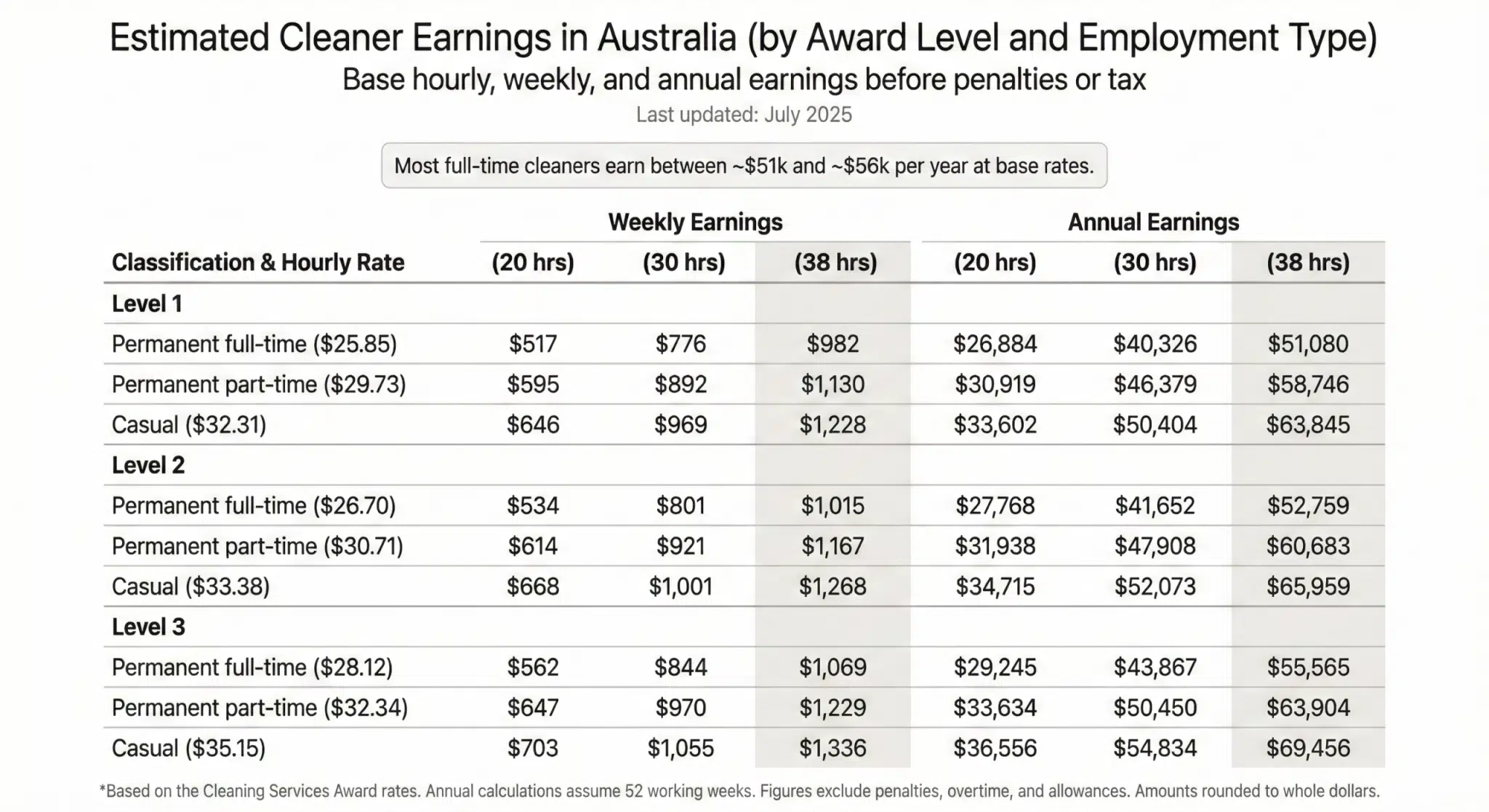
Fair Work – Australia’s national workplace relations system – fixes base hourly wages for cleaners through the Cleaning Services Award. Rates are set according to the type of employment and the skill level you work at.
Let’s take a look at the different levels an employee cleaner may be classified under, what they entail, and the corresponding average pay rates as of July 2025:
Level 1: Standard cleaning tasks, such as dusting, vacuuming, and mopping.
- Permanent full-time cleaner – from $25.85 per hour
- Permanent part-time cleaner – from $29.73 per hour
- Casual cleaner – from $32.31/hr
Level 2: Standard and detailed cleaning tasks, often involving the use of specialised cleaning equipment, such as pressure washers and steam cleaners.
- Permanent full-time cleaner – from $26.70 per hour
- Permanent part-time cleaner – from $30.71 per hour
- Casual cleaner – from $33.38 per hour
Level 3: In addition to standard and specialised cleaning tasks, responsibilities such as supervising cleaning staff and managing day-to-day operations typically apply.
- Permanent full-time cleaner – from $28.12 per hour
- Permanent part-time cleaner – from $32.34 per hour
- Casual cleaner – from $35.15 per hour
Do Casual Cleaners Earn More Than Permanent Cleaners?
Looking at average pay rates, you would think that a casual employee is paid more than permanent cleaners; however, many factors affect the latter’s overall earnings. In other words, permanent staff have higher earning potential, along with company benefits that aren’t typically extended to casual cleaners.
Why Casual Cleaners are Paid More Per Hour
Since casual cleaners aren’t entitled to paid annual leave or job security, they receive an additional 25% casual loading, which amounts to a higher per-hour pay rate. Perhaps, this is the only benefit of working as a casual employee because working hours fluctuate and aren’t guaranteed.
Other drawbacks include lack of priority when it comes to promotions and training programs, as well as zero notice if the company decides to terminate employment. On top of this, you will not receive redundancy pay, but you can expect to be paid your hourly dues in full.
The Benefits of Working as a Permanent Cleaner
As a permanent employee cleaner, the hourly pay rate isn’t as high as what casual cleaners receive, but you can expect more benefits, along with a steady, fixed income with room to grow.
Regular work hours, paid annual leave, superannuation, and other incentives, which vary from company to company, are just some of the benefits permanent cleaners receive. Stability and long-term success are far more conceivable with this type of employment, which is why many cleaners prefer to be employed by an established cleaning business, especially when starting out in the industry.
How An Employee Cleaner’s Earnings are Further Influenced
Apart from the factors mentioned above, there are other ways a cleaner’s pay can be affected. These include promotions, location, or allowances. Again, this varies between companies; however, the principle remains the same.
Promotions and More Responsibilities
New cleaners without prior experience are generally paid a lower entry-level rate, but this is just the beginning for them. As you gain experience, build your skills, and demonstrate reliability, opportunities to take on more advanced or specialised duties open up.
Many cleaners progress into senior, supervisory, or specialist roles over time, which usually come with higher pay. That said, the level of support, training, and career progression varies greatly between employers, making it important to choose a workplace that offers development and long-term career growth. At MaidForYou, the independent cleaning teams we work with have clear pathways to more bookings, with many advancing into roles such as quality checkers and other senior positions.
Location and Market Demand
Although cleaner wages in Australia are guided by Fair Work Awards, which set minimum pay rates across the country, what cleaners actually earn can differ depending on where they work. Location influences a cleaner’s earnings because businesses set rates according to local market conditions. This determines how much they are willing or able to pay their cleaners.
In areas with a higher cost of living, cleaning companies tend to charge more, meaning better pay for cleaners. This is often the case in major cities such as Sydney, Melbourne, Brisbane, and Perth, where demand for cleaning services is consistently high, as is competition for reliable workers. Employers in these regions generally offer higher wages to build a team of experienced cleaners big enough to handle the demand.
Similarly, in cities like Adelaide and Newcastle, where the market for cleaning services is quickly growing, businesses offer higher salaries and more company perks to hold on to their staff. You can expect lower hourly pay in smaller cities, such as Darwin and Cairns, since there isn’t a big demand for professional cleaning services.
Penalty Rates and Overtime
Under Fair Work conditions, cleaners are paid higher hourly rates when working outside regular hours. These increased rates apply to shifts worked on weekends and public holidays, as well as jobs scheduled before 6:00 AM or after 6:00 PM on weekdays. Cleaners may also receive penalty rates for overnight work, particularly for permanent night shifts that finish before 8:00 AM.
In addition, if a cleaner works over the standard 38 hours per week, overtime rates apply. These rates increase further if the additional hours are worked on weekends or public holidays.
Allowances
Cleaners may be paid an additional amount to help cover costs that come with the job. Depending on the role and employer, this can include allowances for using a personal vehicle, travelling between jobs, meals during longer shifts, or uniforms. While these payments are usually not included in the base hourly rate, they can add to overall earnings and help reduce out-of-pocket work expenses.
What Fair Pay Looks Like for Cleaners in Australia
If you’re working as a cleaner or thinking about entering the industry, it’s important to understand whether you are being paid fairly. Reviewing the Cleaning Services Award is the perfect reference for this as it outlines minimum pay rates based on the type of employment and job level.
It’s also a good idea to clarify with your employer how they calculate pay, i.e., whether it includes allowances, overtime, or penalty rates. Another good tip is to check job listings in your area to compare local market rates and see if your current pay is competitive.
Keep in mind, working as a cleaner in Australia is not just about receiving fair pay; job security, consistent working hours, a healthy work environment, workplace support, and opportunities for career growth all make this line of work more valuable.
Enjoy Long-Term Success Working With Maidforyou
At MaidForYou, cleaning teams are treated as valued partners. We focus on creating a positive and supportive workplace where cleaning teams feel safe, respected, and motivated to do their best work.
Our cleaners benefit from consistent working hours and fair pay, giving them stability and peace of mind. We also make sure our team has the equipment, supplies, and support they need, so they can concentrate on doing their job well without extra stress or costs.
As cleaners gain experience, they are encouraged to develop new skills and progress within the company. Many team members continue to build long-term careers in the cleaning industry while working in an environment that values growth, teamwork, and high-quality service.
Explore current opportunities by visiting MaidForYou’s Careers page, where you can learn more about our workplace culture and see what it’s like to be part of our team.